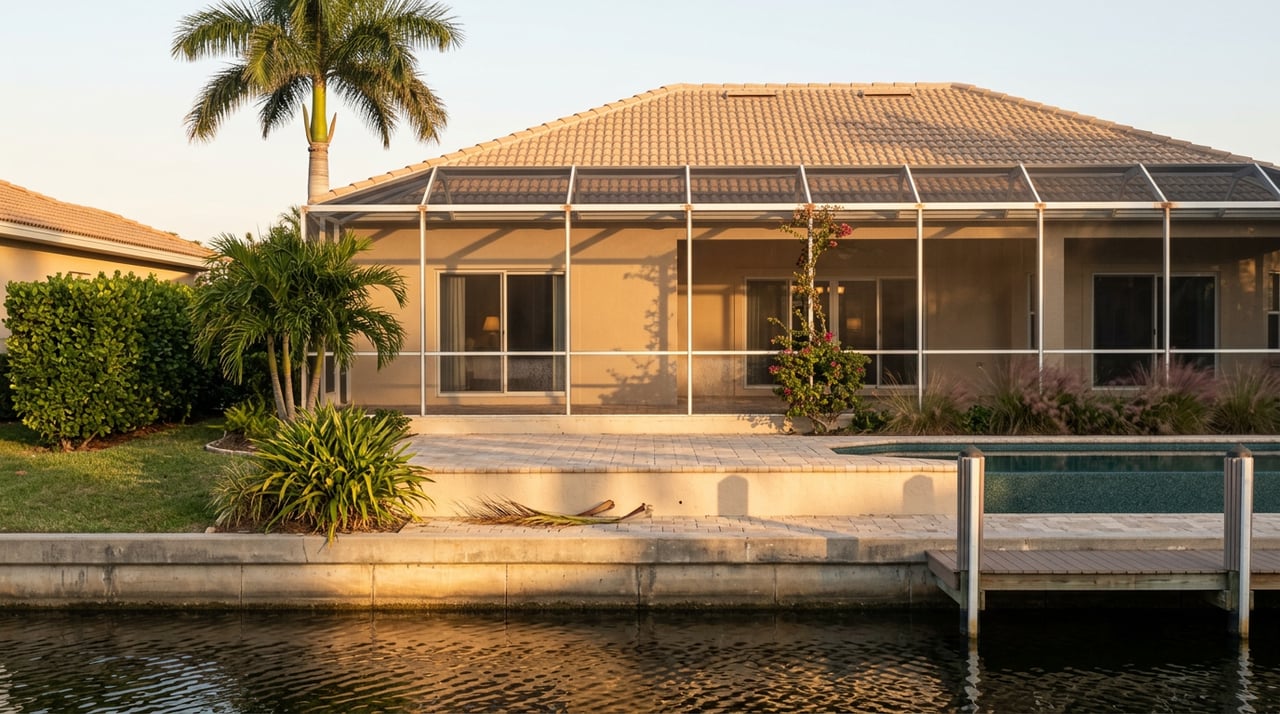
Ask a buyer cross-shopping canal-front homes between Anna Maria Island and the Bradenton mainland what they're paying for, and most will say the water. The Gulf access, the dock, the ability to idle out on a Saturday morning without trailering anything. That's the story the listing photos tell.
It's not quite true. A canal home in Palma Sola and a canal home in Luana Isles on Anna Maria Island can share the exact same water, down to the same bay and the same sound. What separates their price tags by hundreds of thousands of dollars and tens of thousands in annual carrying costs isn't the route your boat takes to the Gulf. It's the flood zone stamped on the parcel, and that stamp has almost nothing to do with how good the boating actually is.
The Water Doesn't Know Which Zip Code It's In
Palma Sola's canal network drains into Palma Sola Bay. From there, boats run through Anna Maria Sound and out to the Gulf passes, the same stretch of water that Anna Maria Island's own canal subdivisions, Luana Isles and Bimini Bay Estates among them, use to reach open water. A center console or small sportfisher leaving a dock on the Palma Sola side isn't taking a lesser route than one leaving Bimini Bay. It's often taking the same one.
That matters because the two markets price this water completely differently. Anna Maria Island's single-family median sale price sat near $2.1 million in early 2026, a figure that has cooled from a 2022 peak around $2.4 million but remains well above the pre-2020 range of roughly $900,000 to $1.1 million. Palma Sola's canal-front housing stock, largely 1960s through 1980s ranch and split-level construction on the Bradenton mainland, sells at a fraction of that per square foot. One canal-front condo in Palma Sola Harbour was listed at $235,000 as of MLS data through March 2026, after a cumulative $65,000 in price reductions, in a community where units routinely come with a deeded dock or boat lift included in the sale.
If the water itself explained the gap, that would be one thing. It doesn't. What explains it is everything attached to the parcel once you cross onto the barrier island.
What the Island Premium Is Actually Insuring
Anna Maria Island sits entirely within FEMA-designated flood zones, and under FEMA's Risk Rating 2.0 methodology, premiums are now priced to the individual property rather than a community average. On a lower-elevation waterfront parcel in Zone AE, expect annual flood insurance between $4,000 and $8,000. Zone VE parcels, the coastal high-hazard designation that applies to some Gulf-front and bayside lots, routinely run $10,000 to $12,000 or more per year. Stack that against property tax, HOA dues where applicable, and the maintenance that salt air and storm exposure demand, and total annual carrying cost on a median-priced Anna Maria Island home has been reported above $30,000 before a mortgage payment is factored in.
Palma Sola carries flood exposure too. It's mainland Bradenton, not immune to storm surge or the Manatee County flood maps that show risk along the Palma Sola Bay shoreline. But the mainland's mix of flood zones is broader, and the housing stock, especially the older interior neighborhoods, more often sits outside the highest-risk VE and AE designations that dominate barrier island parcels. Some Palma Sola Harbour condo listings note HOA dues of $650 to $675 a month that fold in a master flood insurance policy, effectively pricing that risk into a fixed line item rather than leaving it to a separately shopped annual premium.
That's the real mechanism behind the price gap. You're not paying more on Anna Maria Island because the boating is meaningfully better. You're paying more because the regulatory and insurance overlay on a barrier island parcel is heavier, and that overlay gets capitalized into the sale price the same way property tax rates get capitalized into home values anywhere else.
The Bridge You Can't See in the Listing Photos
Here's the part that doesn't split neatly along the island-versus-mainland line. Whether the water access is actually as good as advertised depends on details that have nothing to do with which side of the bay you're on.
Anna Maria Island's Luana Isles subdivision, one of the island's larger waterfront pockets, has a low fixed bridge on Crescent Drive that caps the mast height of any boat trying to get out to Anna Maria Sound. A buyer who assumes every AMI canal lot delivers unrestricted Gulf access can end up with a boat that doesn't fit under the bridge on their own street.
Palma Sola has the same kind of variation. Some canal routes reach Palma Sola Bay with no fixed bridges at all, which matters if you're bringing a sailboat or anything with real air draft. Others require passing under a drawbridge, which is a different planning problem but not necessarily a dealbreaker. The point isn't that one side of the bay is more reliable than the other. It's that bridge clearance is a property-specific fact, not a zip-code fact, and it gets buried in listing copy that talks about "Gulf access" as if every canal delivers the same thing.
The same is true of canal depth at low tide. A dock that looks identical to its neighbor's can sit in water that's two feet shallower when the tide runs out, which matters enormously if you're planning to keep anything larger than a small skiff there year-round.
Five Things Worth Checking Before the Address Decides Anything
Whether you're looking at a canal home in Palma Sola or one on Anna Maria Island, the diligence list is the same, and none of it shows up in the median price:
- Seawall condition and remaining useful life. This is the most common deferred-maintenance item on older canal-front homes in this market, and replacement runs into five figures. A seawall built in the 1970s that hasn't been inspected recently is a real unknown, not a cosmetic one.
- Canal depth at low tide. Ask for actual soundings if you're planning to keep a boat with real draft. A dock that looks fine at high tide can strand a boat twice a day.
- Bridge clearances on the route out. Confirm the path from the specific dock to open water, not the general reputation of the neighborhood. Luana Isles and parts of the Palma Sola canal system both have fixed bridges that cap boat size.
- Dock permitting status. A dock built without permits, or one that predates current setback rules, can complicate insurance and resale.
- Whether the HOA fee, if there is one, includes a master flood insurance policy. Several Palma Sola Harbour listings fold flood coverage into a $650 to $675 monthly fee. That's a materially different cost structure than shopping flood insurance separately, and it's worth confirming in writing rather than assuming from the listing description.
If You Want the Water Without the Waterfront Price
Palma Sola isn't only a canal-front market. The interior streets, subdivisions like Cordova Lakes, Mount Vernon, and Pine Bay Forest running south of Manatee Avenue, sit back from the water entirely. They carry generous lots and mostly no HOA structure, and they trade at meaningfully more accessible price points than the canal-front homes a few blocks over. For a buyer who wants Palma Sola's location and lifestyle without waterfront carrying costs or seawall risk, this interior stock is the honest answer, not a downgrade.
The managed-amenity communities at the western edge, Perico Bay Club, Palma Sola Harbour, and Mangrove Walk on Harbour Isle, sit in between. They carry HOA fees and governance that the older interior streets don't, but they also bundle amenities and, in some cases, that flood insurance line item, into a single predictable cost.
The Park That Doesn't Care Which Market You're In
Two minutes inland from any of these canals sits Palma Sola Botanical Park, a 10-acre site that began in 1990 when local residents organized to save a former Manatee County plant nursery from redevelopment. The nonprofit foundation that runs it today, incorporated in 1993, charges no entrance fee and takes no government funding, relying entirely on donations to stay open seven days a week. It's smaller and more curated than Northwest Bradenton's 682-acre Robinson Preserve, which draws the serious trail and kayak crowd, but for a buyer whose daily life will revolve around a dock rather than a hiking trail, it's the kind of quiet, walkable green space that doesn't show up in a listing sheet and doesn't care whether your address sits on the mainland or the island.
That's worth sitting with as you compare these two markets. The price difference between a Palma Sola canal home and its Anna Maria Island counterpart is real, and it's driven by flood zone designation and insurance structure more than by any difference in the water itself. What actually determines whether either purchase works for you, the seawall's condition, the bridge on your specific route, the depth at your dock, doesn't correlate with the zip code at all. It correlates with the parcel.
If you're weighing a canal-front purchase anywhere between Palma Sola and the barrier islands, The Castro Group can walk the specific route, the specific seawall, and the specific flood zone with you before you write an offer. Schedule a consultation today.
Frequently Asked Questions
Does every canal in Palma Sola lead to the Gulf without a fixed bridge? No. Some stretches of the Palma Sola canal system reach Palma Sola Bay with no fixed bridge, which matters for sailboats and anything with significant mast height. Others require passing under a drawbridge. Verify the specific route from any dock you're considering rather than assuming based on the neighborhood's general reputation.
Do all Palma Sola condo HOA fees include flood insurance? Not all of them. Several listings in Palma Sola Harbour specifically note a master flood insurance policy bundled into monthly dues of roughly $650 to $675, but this varies by building and by community. Confirm what's included in writing before assuming the HOA fee covers flood coverage.
